Best accounting & bookkeeping software for solopreneurs in Europe (2026)
The best accounting and bookkeeping software for solopreneurs, freelancers and the self-employed in Europe — Xolo, Holded, Zoho Books and Bonsai compared, plus when a country-specific tool beats a pan-EU one. Honest picks for a team of one.

Solo operator · one-person venture studio in Europe (SEO · affiliate · micro-SaaS) · 19 June 2026 · updated 19 June 2026 · 7 min read

Every solopreneur eventually meets the same quiet tax: the books. Whether you call it accounting, bookkeeping, or just “the admin I keep putting off,” the job is identical — record what came in and went out, get the VAT right, and have clean numbers at year end. As a team of one, you are the founder, the invoicer and the bookkeeper, so the tool you pick decides whether that role costs you a few clicks a month or a lost weekend every quarter.
This is the pan-EU shortlist for the self-employed — freelancers, sole traders, indie builders and one-person companies — with one honest rule built in: if you are taxed in a big-mandate country, a local specialist usually wins, and I point you to it rather than pretend a generic tool files German or Italian taxes best.
How I evaluated these. For a solo, accounting software should: cover the whole chain (capture → categorise → VAT → year-end), handle EU VAT (and reverse charge / OSS where relevant), support multi-currency if you bill across borders, run in English, and either file for you or export cleanly to an accountant. Deep enterprise features are optional; not losing a weekend to your books is not. Figures below are approximate 2026 numbers — verify current pricing and tax rules with the vendor or an accountant before relying on them.
At a glance
| Tool | Best for | Books done by | Multi-currency | English | From |
|---|---|---|---|---|---|
| Xolo | Hating admin entirely | Software + real accountant | ✅ | ✅ | ~€59/mo |
| Holded | Self-serve that scales | You | ✅ | ✅ | ~€10–30/mo |
| Zoho Books | Cheapest serious option | You | ✅ (strong) | ✅ | ~€0–20/mo |
| Bonsai | Freelancer all-in-one | You | ✅ | ✅ | ~€20–40/mo |
| Country specialist | DE/FR/IT/ES local filing | You / local accountant | — | varies | see below |
1. Xolo — for the solo who wants the books to just disappear
Xolo
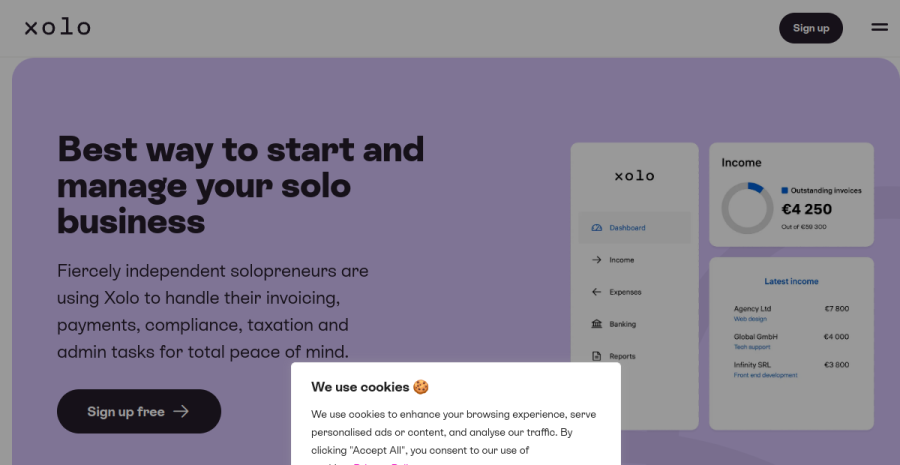
Xolo is the first thing I recommend to a service solopreneur who would rather do anything than bookkeeping. It pairs clean software with a real accountant, so invoicing, expense tracking, VAT and your filings are handled together — and for an Estonian e-resident, Xolo can also be your company (Xolo Leap) or run you as a solo trader (Xolo Go). The whole thing is in English.
Why it leads here. For a one-person service business, the value isn’t a slicker dashboard — it’s not having to learn accounting at all. You send invoices, forward receipts, and the books (and the person responsible for them) exist without you becoming a bookkeeper.
Worked example. A borderless consultant running through an Estonian OÜ bills EU and non-EU clients. Xolo Leap handles the company, the bookkeeping, VAT and the annual report — in English, for a predictable monthly fee instead of a local accountant’s hourly bill.
Pros: real accountant included; English-first; great for e-residents/borderless solos; one place for invoicing, books and filing. Cons: pricier than pure software (you’re paying for the human); strongest in the Estonian/e-residency model; less ideal if you specifically need deep local filing in a big-mandate country.
2. Holded — the best self-serve accounting that scales
Holded
Holded is the pick when you want to run the books yourself but not outgrow your tool in a year. It’s a full accounting/ERP platform — invoicing, expenses, banking, VAT, reporting, even inventory and CRM — that’s genuinely usable by a solo yet scales if you ever add a contractor or two. EU-built, multi-language, multi-currency.
Why it’s here. Most “freelancer” tools hit a ceiling fast; Holded is the rare one a one-person business can grow into rather than out of, without migrating data later.
Pros: full accounting depth; scales past solo; multi-currency and multi-language; strong reporting. Cons: more than a very simple freelancer needs; Spanish-origin so verify your country’s specific filing/e-invoicing fit; a steeper learning curve than the minimalist tools.
3. Zoho Books — the cheapest genuinely serious option
Zoho Books
Zoho Books gives you real, full-featured accounting at the lowest serious price point — including a free tier for very small turnover. It’s strong exactly where cross-border solos hurt: multi-currency, EU VAT handling, automation, and a clean mobile app, all inside the wider Zoho ecosystem if you ever want CRM or email alongside.
Why it’s here. For a price-sensitive solo who bills in several currencies and wants proper books (not just invoicing), nothing matches Zoho Books on value.
Pros: excellent value (free tier + cheap paid); strong multi-currency and EU-VAT support; lots of automation; big ecosystem. Cons: the ecosystem can feel sprawling; support is more self-serve; verify local e-invoicing-mandate coverage for your specific country.
4. Bonsai — the all-in-one for freelancers
Bonsai
Bonsai bundles accounting and invoicing with the rest of a freelancer’s admin — contracts, proposals, a simple CRM, time tracking and tax set-aside estimates — in one app. If your pain isn’t only the books but the whole client-admin sprawl, having it in a single place is the draw.
Where to be careful. Bonsai is US-origin, so its strength is the freelancer workflow rather than deep EU-specific tax filing. Verify it handles your EU VAT and any local e-invoicing mandate before relying on it for compliance — treat it as “all-in-one admin + bookkeeping,” and pair it with a local accountant for the country return if needed.
Pros: genuinely all-in-one (contracts, CRM, invoicing, books, tax estimates); great freelancer workflow; clean UX. Cons: US-centric tax model — verify EU VAT / e-invoicing fit; pricier than a pure bookkeeping tool; some features overlap things you may already use.
If you’re taxed in a big-mandate country, start local
This is the honest part most generic roundups skip. If your tax home is Germany, France, Italy or Spain, a tool that files the local way — and meets that country’s e-invoicing mandate — almost always beats a pan-EU generalist. We have a dedicated, deeper roundup for each:
- 🇩🇪 Best accounting software for German freelancers — ELSTER, EÜR, XRechnung/ZUGFeRD, Kleinunternehmer.
- 🇫🇷 Best accounting software for French freelancers — URSSAF, Factur-X, micro-entrepreneur.
- 🇮🇹 Best accounting software for Italian freelancers (partita IVA) — FatturaPA/SdI (already mandatory), regime forfettario.
- 🇪🇸 Best accounting software for Spanish autónomos — Verifactu, IVA/IRPF.
A common, sensible setup: a pan-EU tool (or accountant) for the day-to-day books, plus a local specialist or commercialista/Steuerberater/gestoría for the annual return.
What about free? (Wave, and the honest caveat)
If your business is genuinely simple, Wave offers free accounting and invoicing and is a fine starting point. The caveat: free tools are thin on EU-VAT, multi-country and e-invoicing-mandate support. Free is fine until compliance enters the picture — then a cheap paid tier that gets VAT and filing right is worth far more than it costs.
How to choose
| If you… | Start with |
|---|---|
| Want to never think about books (accountant included) | Xolo |
| Want full self-serve accounting that scales | Holded |
| Want serious books at the lowest price / multi-currency | Zoho Books |
| Want contracts, CRM and books in one freelancer app | Bonsai |
| Are taxed in DE/FR/IT/ES | The country specialist above |
| Have a very simple business and want free | Wave (mind the VAT caveat) |
The blunt summary: outsource the books → Xolo; DIY and scale → Holded; DIY on a budget → Zoho Books; all-in-one freelancer admin → Bonsai; big-mandate country → go local. Every option has a free tier or trial, so test before you commit.
Where bookkeeping fits in the bigger admin picture
Accounting is one link in the solo “money & admin” chain. The neighbours worth getting right at the same time:
- Invoicing & getting paid — the invoicing & accounting tools roundup and getting paid across borders.
- VAT specifically — EU VAT & OSS explained and automated VAT-filing tools.
- E-invoicing mandates — EU e-invoicing by country, now compulsory in several countries.
- The habits that keep it painless — bookkeeping habits for solopreneurs.
- The business bank account underneath it — best EU business bank accounts.
Bottom line
For most EU solopreneurs the choice is really do I outsource the books or not. Outsource → Xolo. Do it yourself → Holded (scaling) or Zoho Books (budget). Want everything in one freelancer app → Bonsai. And if you’re taxed in Germany, France, Italy or Spain, the local specialist beats them all for filing. Pick one, set it up once, and turn “the admin I keep putting off” into a setting.
Let an accountant handle it with Xolo →
Not sure where to begin? The whole money-and-admin sequence for a one-person business is in how to start and run a one-person business in Europe.
Frequently asked questions
What is the best accounting software for solopreneurs in Europe?
What is the difference between accounting and bookkeeping software?
Is there free accounting software for the self-employed?
Do I need country-specific accounting software or a pan-EU tool?
Keep reading
Bookkeeping for solopreneurs: 9 habits that keep your books clean (and your tax bill lower)
Practical accounting and bookkeeping tips for solopreneurs, freelancers and the self-employed — the 9 habits that keep your books clean, your VAT correct and your tax bill lower, without becoming an accountant.
How to register as a freelancer / self-employed in Switzerland (2026)
The structural guide to going self-employed in Switzerland — setting up an Einzelfirma (sole proprietorship / raison individuelle), getting your self-employed status recognised by the cantonal AHV/AVS compensation office, when the commercial register becomes mandatory, Swiss VAT (MWST/TVA) registration, cantonal and federal income tax, and keeping records.
How to register as a freelancer / self-employed in Austria (2026)
The structural guide to going self-employed in Austria — the Gewerbe (regulated trade, WKO membership) vs Neue Selbständige distinction, registering with the Finanzamt for income tax, SVS social insurance, the Kleinunternehmer VAT concept, and when you outgrow being a sole trader.
Everything here is free. If something saved you time, you can support the author — no product, no signup.